
Our Story & Beliefs
Who Are Episcopalians?
We are part of the worldwide Anglican Communion—a family of churches that shares roots in the Church of England and has grown into a global tradition shaped by many cultures and contexts.
The Episcopal Church is the American expression of that tradition. It took shape after the American Revolution, as Christians sought to remain rooted in the beauty and depth of Anglican worship while living independently of royal authority. Our first bishop, Samuel Seabury, was consecrated in 1784, and since then the Episcopal Church has continued to grow and evolve in its own context.
What makes us distinct is not a single idea, but a shared way of life shaped by prayer, worship, and community:
The Book of Common Prayer
Our worship is shaped by a shared liturgy that has deep historical roots and is prayed across the Anglican world today. It connects us to Christians across time and place, forming us through patterns of prayer that are both ancient and accessible.
Shared Leadership in the Church
The Episcopal Church is led by bishops in historic apostolic succession, but governance is shared among bishops, clergy, and laypeople. This reflects our belief that the whole Church participates in discernment and leadership.
Rooted in the Whole Christian Tradition
We are shaped by the Reformation and fully Protestant in origin, while also retaining much of the sacramental and liturgical life of the early Church. This blend gives Episcopal worship a rhythm that is both historic and living.
Scripture, Tradition, and Reason
We read the Bible in conversation with the wisdom of the Church through the centuries and with the gift of human reason. Together, these guide us toward faithful interpretation and a grounded, thoughtful faith.
Our Beliefs
We follow Jesus Christ, whose life, death, and resurrection bring life to the world. God loves you—no exceptions. All are fully welcomed into worship, leadership, and service.
The Trinity
We believe in one God who exists in three persons: Father, Son, and Holy Spirit. God the Father is the Creator of all things. Jesus Christ, the Son, is God made known in human life, who teaches, redeems, and reconciles the world to God. The Holy Spirit is God present and active in creation, guiding, sustaining, and inspiring us in faith. Though distinct, these three are one God, shaping the Church’s worship, prayer, and life in the world.
The Bible
We believe the Holy Scriptures contain all things necessary for salvation and guide us into a deeper relationship with God. In The Episcopal Church, the Bible is read at the heart of worship and understood through tradition and reason. Scripture shapes the prayers of the Church, including much of the Book of Common Prayer, which is deeply rooted in biblical language.
Jesus
We believe in Jesus Christ, the Son of God, who is fully divine and fully human. He is the eternal Word made flesh, the promised Messiah, who lived among us, taught the way of love, died on the cross, and rose again to bring new life to the world. Through his life, death, and resurrection, we are reconciled to God and invited into life in his kingdom.
In him, we see the perfect image of God’s love. By grace, we share in his victory over sin and death through baptism and new life in Christ. We affirm that Christ will come again in glory, and that nothing can separate us from God’s love in him.
Salvation
We believe salvation is God’s gift of restored relationship with God and one another, made possible through Jesus Christ. In Christ’s life, death, and resurrection, God’s saving love is fully revealed, bringing us from sin and death into new and abundant life.
This salvation is shared with us by the Holy Spirit, especially through baptism and the Eucharist, where we are united with Christ and nourished by his life. It is both present and ongoing: we are being formed into the likeness of Christ even now, while we await the full coming of God’s Kingdom.
In this “already but not yet” reality, we live in hope that all creation will one day be united in God’s love, and that nothing can separate us from that love in Christ Jesus.
Baptism
Baptism is full initiation into the Body of Christ, the Church. In baptism, God adopts us as beloved children, forgives sin, and unites us with Christ in new life through water and the Holy Spirit. It is the foundation of Christian life and ministry, marking us as Christ’s own forever.
In The Episcopal Church, baptism is a communal act, with sponsors and the whole congregation promising to support the newly baptized in faith. It is celebrated in the name of the Father, Son, and Holy Spirit, and often marked with the sign of the cross as a sign of belonging to Christ.
The Church
The Church is the Body of Christ, gathered by God for worship, formation, and mission. It is a community called to proclaim the Good News and live as Christ’s presence in the world.
While God is active everywhere, the Church is where we encounter Christ in a particular way through Word and Sacrament, and are formed for lives of faith, love, and service.
Prayer
Prayer is our response to God and the opening of a living relationship with him. It can take many forms: words of petition, praise, and thanksgiving, as well as silence, listening, and contemplation.
In The Episcopal Church, prayer is understood as our response to God the Father, through Jesus Christ, in the power of the Holy Spirit, shaping both our worship and our daily lives.
Our Story
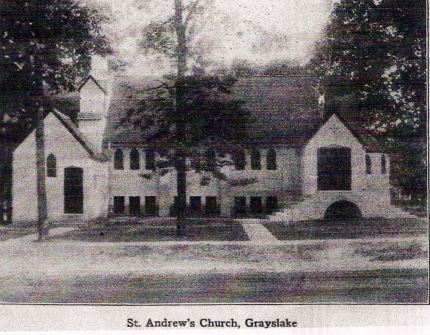
1907—The first Episcopal service held in Grayslake. Officiated by The Rev. William E. Toll.
1914—The Ladies’ Auxiliary raises the $1,000 to purchase the current property at the corner of Park Ave and Lake Street.
1927—Cornerstone laid on St. Andrew’s Day. The Rev. Humphrey Campbell Dixon becomes priest. First services held in the new church building a year later.
1942—St. Andrew’s Church is consecrated.
1955—Parish hall, kitchen, expanded seating, and choir loft are completed. St. Andrew’s is granted parish status.
1966—Addition completed with offices, classrooms, and meetings rooms.
2004—Elijah’s Mantle is founded to provide gently used children’s clothing to families in need.
Today—a vibrant and growing parish rooted in the life of worship opens its doors to you.